
"...Our Pilgrim's Pride?"
My Country, "Tears" of Thee."

Is it, “Tears of Thee,” or “Tis of Thee?” I often get the two confused, specifically since they are so profoundly interchangeable in the historical record of this land. I know, I know, I know, it’s extremely hard for people to separate the physical realm from the spiritual one, and since they can’t they often try to take mundane “things” that happen on a physical level, and spin them into some sort of “spiritual thing.” A lot of times it’s not. Now, there are times when esoteric or spiritual “things” are at play, but discerning such is for most people is like deciphering Chinese calculations on physics. See, in order to have any level of discernment there must be knowledge, information, and the ability to critically think.
Most people rarely study anything. this is why I force people to study “tid bits” of verifiable information, in order to help individuals who are truly serious, develop a sense of discernment, even if shallow. Over this journey with writing here, I find the same patterns that I have seen in teaching Martial Arts classes. Most people come to the school looking for some sort of “Hollywood-ish” situation. They want advanced techniques, and they want it, “now.” Granted, they could, “get it now,” if they trained 8 hours a day and mastered their degrees. Nope. They want to come in on Saturday, or a weekday, train for 45 minutes and then leave.
That is the same mentality with building and developing an intellect that would cultivate discernment, and hopefully preclude the person from becoming a “life long fool.” A chump. In the streets they used to say, “Suckers like to get beat.” Meaning, “People love to be fooled.”
“Mundus vult decipi, ergo decipiatur, a Latin phrase, means "The world wants to be deceived, so let it be deceived."
With the aforementioned as a foundation, “What other “thing” am I being deceived about? What other thing am I not being told the truth about?” The Pilgrims.
This subject is tough for a lot of people, but just to clarify, “It can’t EVER GET TOUGHER ON ANYONE THAN IT IS ON ME AND MY FAMILY.” Why? William Bradford of Plymouth Colony was blood, and HE WAS RIGHT IN THE MIDDLE OF ALL OF IT.” See, my family has been on this land since before the French, Spanish or English ever got here, and since we have, there are not many people mentioned in “popular history” that we are not related to. Directly related. When the Europeans came here, “Who were they snuggling up with?” Our females. That’s how we got these names.
So, when I write or speak on Pilgrims I feel like I have that right on both sides of it. On the American Indian side and the Mayflower descendant side. I know, I know, I know, the emotional side of some people are going to find the following abrasive, and I don’t mean it to be so, however I believe that it is sometimes necessary in order to find a place of closure. Most people however who are “grown,” really do prefer to be spoken to like teens or children.
The “adult side” of the Pilgrim story is that they were just, “The same ole soup warmed over.” The same nonsense about some sort of “god,” that history evidences is a devil, gave them divine control over the lands and property of other “Confederacies” of tribes that had been on the land since forever. It is a strange dogma that cannot hold scrutiny in any court of competent jurisdiction, “because it’s unprovable,” and even in “common sense” it flounders. Never mind all of that, “It worked.” It worked so well they even wrote songs about it, “To gas up the population,” or boost moods of the people in their times of gloom; and who better to “gas ‘em up” than, The Pilgrims.
“Samuel Francis Smith was a twenty-four-year-old Baptist seminary student in Massachusetts when he wrote the lyrics of “America (My Country, ’Tis of Thee),” the patriotic song that would serve as an unofficial national anthem for nearly one-hundred years. In 1831, while studying at Andover Theological Seminary, Smith was asked by composer Lowell Mason to translate some German song books. Inspired by one of the German songs— “God Bless Our Native Land” (set to the tune of “God Save the King”)—Smith set out to write an original patriotic song for America set to the same melody. The result was what Smith called “America” and what would eventually be better known as “My Country, ’Tis of Thee.”
“The song was first performed on July 4, 1831, by a children’s choir in Boston. Smith’s lyrics invoked the history of America—
“Land where my fathers died, Land of the Pilgrims’ Pride, From every mountain side Let freedom ring”—as well as its beauty and sense of itself as a blessed land—“I love thy rocks and rills, Thy woods and templed hills, My heart with rapture thrills, Like that above.”
“America” soon took on a life of its own, quickly becoming widely known and well loved, and the song served as an unofficial national anthem until the adoption of “The Star-Spangled Banner” in 1931. In 1864, in the midst of the Civil War, Smith sent a copy of the song to former US Representative J. Wiley Edmands of Massachusetts. More than thirty years after he composed the lyrics to “America,” Smith wrote of the words’ enduring power: “I am happy to have been the means through them of adding a momentary joy to a festive, or light to a gloomy hour.”
“The verses below were copied out by Smith in 1886:
“America” My country, ’tis of thee, Sweet land of liberty, Of thee I sing; Land where my fathers died, Land of the Pilgrims’ Pride, From every mountain side Let freedom ring.”
“My native country, thee, Land of the noble, free, Thy name I love; I love thy rocks and rills, Thy woods and templed hills, My heart with rapture thrills, Like that above.”
Let music swell the breeze, And ring from all the trees Sweet freedom’s song; Let mortal tongues awake, Let all that breathe partake, Let rocks their silence break, The sound prolong.
Our fathers’ God, to Thee, Author of liberty, To Thee we sing; Long may our land be bright, With freedom’s holy light, Protect us by Thy might, Great God, our King.”
https://www.gilderlehrman.org/sites/default/files/inline-pdfs/05508.230.01_FPS.pdf
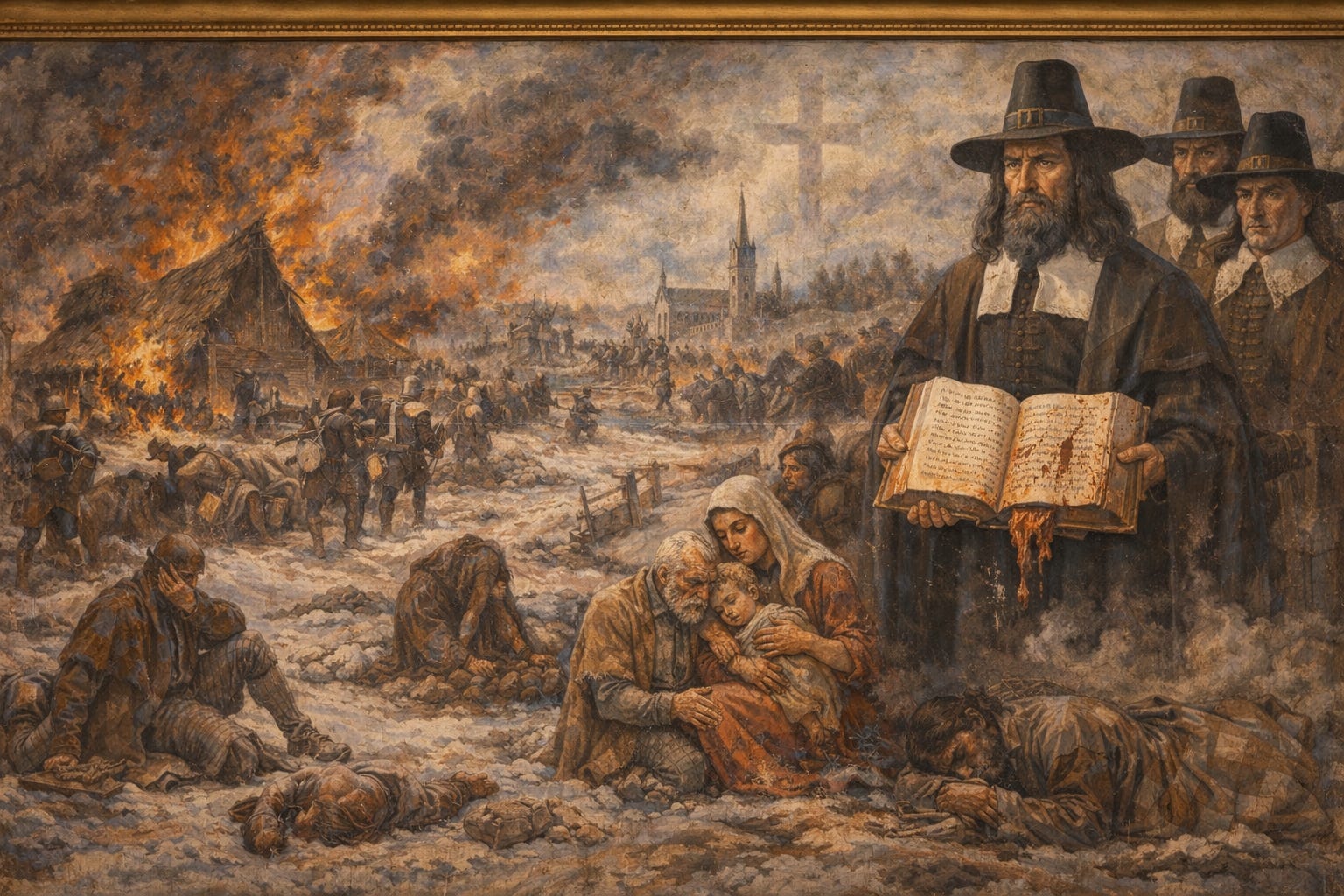
Who are the Pilgrims, and what was their “get down?” What did they do? See, when most people think about the early colonies, they think about, “Oh the poor Indians, they must have really suffered.” We did. We do, but this is manifest, history has evidenced it quite clearly. This is not about that. Take a second look at the image. Where are the American Indians? Huh? Who is there?
There is a whole ‘nother aspect to the colonization “get down” that most people have no idea about, to wit, “The way that the settlers who came here were treated by The Pilgrims.” Who believes the Pilgrims were a benevolent group?
What simple minded, naive, fool believes for one nanosecond that the “regular White folk” were treated with dignity and respect? LOL. If somebody is that retarded in intellect then post your bank account and routing numbers in the comments below so I can help you get 10,000,00.00 from a Nigerian “hut dweller” Prince in Lagos.
The regular “White” folk who came in the colonies came in as slaves. They got treated like dirt by the Pilgrims and all early Messianic groups. I have covered this previously here:
Let’s be clear, anyone not on board with the Pilgrim’s Messianic delusion, “They got dealt with.” Period. Contrary to popular tales, there wasn’t some sort of “pioneering spirit” of “settlers striking out on their own” and other fantasies. Nope. They were under the strict scrutiny and thumb of hardcore Messianic fanatics who kept the people docile and “petrified,” with the “ever-present threat” of Indians, or the killing of Indians, as a control mechanism.
“You need us to survive, the “Negros” are gonna get you. They’re cannibals.”
So the naive people of the colonies “hung around and got mistreated.” They were too scared and destitute to do otherwise. The people under the thumb of the colony had to “go along to get along” or they got exiled, beat or even killed. This meant “full on delusional Messianic rhetoric,” backed by force of arms, “24-7-365.” This meant the females and women were nothing. This meant normalized humiliation and abuse for women and children. Women were considered work animals. The had no rights, and if a man was not publicly “knocking fire from them regularly,” the man would be considered “soft.” A “real man” had to “show and prove” in public.
“See, that’s how you correct them. The “lord” is pleased with the rod,” they cheer. As the “headright-man” lifts his woman’s unconscious body onto the back of the wagon.
“Well, done Jeremiah-Ezekiel, we take comfort in the display of your devotion to the lord,” says The Pilgrim Elder. “I know, it’s blessing to serve,” says the Headright-man, as he smiles and rides away. “Indeed, my son, indeed.”
While the Pilgrims were doing dirt to American Indians they were also utilizing the brutality as a reminder to other witnesses in the colonies that, “You can get this work too. Step out of line and you can be dealt with exactly the same.” In the name of some sort of “god” of course. Remember, the evil was directed at American Indians, and Whites, “who got in the way.” The Whites who got in the way were downed right along with Indians, because both groups stood in the way of the theft and fraud. American Indians always treated “individual Whites and families” with dignity and respect. It is our way.
“Page 791: An account of the Feather River Indians assisting two lost emigrants. "They compassionated the circumstances of these poor white men, gave them root-bread, small fish, and a wild duck, from their precarious supply of food. Were afraid of the guns, desiring the whites to do as they had done - throw down their arms. A tall aged man, they thought was a chief, came up, and made signs and embraced them. He pointed up, and to them - Indians and whites; and seemed to say, that they were all common children of "One God.”
None of that matters. None of it matters because it is bigger than “Whites,” morality or humanity, it’s about a dogma of evil that masquerades as “everything else.” This is why it was so easy to harm their own if they “stepped out of line.” Nobody was bigger than the program, and the program was Messianic, exterminationalist, END TIMES, extremist fanaticism. Think about that? Think about the most rabid, insane religious woman hating, racist cults, and then multiply it by 100 and add avarice, more mental illness, alcohol and legal, open violence. That’s the “Pilgrims Pride.”
Sacred Chosenness, Collective Psychology, and Harm in North America
Abstract
This report examines the psychological mechanisms underlying messianic and chosenness-based religious movements in North America and analyzes their material effects on American Indians and other out-groups. Using interdisciplinary scholarship from social psychology, religious studies, history, and political theory, the report identifies recurring cognitive and group-dynamic patterns—collective narcissism, moral disengagement, sacred entitlement, and out-group dehumanization—and traces their manifestation across major movements from the seventeenth century to the present. The analysis demonstrates that harm was not incidental but structurally produced by belief systems that sacralized power, territory, and identity.
I. Conceptual Framework: Psychology of Sacred Chosenness
A. Collective Narcissism
Definition: A group-level belief in exceptional moral worth requiring external validation and defended through hostility when challenged.
Operational Effect:
Fragile superiority produces aggression toward dissenters and outsiders.
Violence and domination are reframed as defensive or redemptive.
B. Sacred Entitlement
Definition: The belief that divine selection confers rights beyond ordinary moral or legal constraint.
Operational Effect:
Land, labor, and life become morally claimable resources.
Accountability is displaced by appeals to providence.
C. Moral Disengagement (Bandura)
Mechanisms:
Moral justification (”God commands it”)
Euphemistic labeling (”clearing,” “civilizing”)
Dehumanization (heathen, savage, enemy of God)
Displacement of responsibility (obedience to divine authority)
D. Apocalyptic or Covenant Anxiety
Definition: Persistent fear that failure to dominate or purify will result in divine punishment.
Operational Effect:
Preemptive violence
Intolerance of pluralism
Obsession with purity, loyalty, and conformity
II. Foundational Case: Puritans (17th Century)
Psychological Profile
Self-identification as New Israel
Covenant theology producing binary moral categories
Chronic fear of divine withdrawal
Effects on American Indians
Dehumanization of Indigenous nations as Canaanites
Sanctification of massacre (e.g., Pequot War)
Rationalization of village burning, enslavement, and child killing
Structural Outcome
Violence normalized as governance
Theology embedded in colonial law and precedent
III. Subsequent Messianic and Chosenness-Based Movements
1. Manifest Destiny Protestantism (19th Century)
Psychological Drivers:
National collective narcissism
Secularized providentialism
Effects:
Forced removals (Trail of Tears)
Ethnic cleansing of Plains and California Indians
Legal doctrines erasing Indigenous sovereignty
2. Mormon Settler Theology (19th Century)
Psychological Drivers:
New sacred history centered in America
Chosen remnant identity
Effects:
Territorial conflict with Indigenous tribes
Early theocratic violence
Eventual institutional moderation without repudiation of entitlement
3. Christian Reconstructionism / Dominion Theology (20th Century)
Psychological Drivers:
Desire for total moral control
Anxiety over secular pluralism
Effects:
Policy advocacy hostile to Indigenous rights, religious minorities, and civil liberties
Theological legitimation of authoritarian governance
4. Evangelical Christian Nationalism (Late 20th–21st Century)
Psychological Drivers:
Perceived loss of chosenness
Victimhood-infused narcissism
Effects:
Increased tolerance for political violence
Delegitimization of Native sovereignty, immigration, and minority rights
Moral exemption for in-group transgressions
5. Apocalyptic Sects and Militias
Psychological Drivers:
Paranoid cognition
Absolute moral binaries
Effects:
Episodic violence against civilians and state actors
Reinforcement of broader chosenness narratives
IV. Effects Beyond American Indians
Negro Americans
Biblical sanctioning of slavery
Racialized chosenness narratives
Religious Minorities
Catholics, Jews, Muslims framed as existential threats
Legal and social exclusion
Women and Internal Dissenters
Purity enforcement
Gendered moral control
Punishment of deviation
V. Why These Patterns Persist
Institutional Success: Early violence rewarded with land and power
Mythic Memory: Atrocities reframed as founding heroism
Legal Inheritance: Doctrines embedded in law outlive belief
Psychological Utility: Chosenness resolves anxiety and uncertainty
VI. Analytical Conclusion
The repeated harm inflicted by messianic and chosenness-based movements in North America is best understood not as aberrant fanaticism but as the predictable outcome of group psychological dynamics reinforced by sacred narratives. From the Puritans to modern Christian nationalism, these belief systems have consistently:
Elevated in-groups beyond moral constraint
Dehumanized outsiders
Sacralized coercion
Produced durable harm to American Indians and others
The Pequot War thus functions not only as a historical atrocity but as a psychological template—one replicated whenever sacred entitlement overrides ethical reciprocity.
VII. Implications for Scholarship and Policy
Necessity of psychological literacy in religious freedom analysis
Re-evaluation of founding myths in legal education
Recognition of belief-driven harm as structural, not incidental
This report is intended for academic, legal, and interdisciplinary use. (finis)
There is more to this Messianic “thing.” See, I also believe that by design it did to American Indians what it has done to others, and if not dealt with from a psychological perspective it will keep happening again. When “religion” is removed it is a very destructive doctrine that evidences “layers of profound, pronounced delusional personality disorders in the participants historically and currently.” To be simple, “It’s evil.” An evil broadcast from the pulpit. “Pull-into the Pit.” The “Pit” of those, “Pulled” out of the population. Strange name.
Sacred Chosenness and Indigenous Erasure
Sermons, Psychology, and Colonial Violence in Early North America
Abstract
This report examines how messianic and chosenness-based Christian belief systems in early North America operationalized violence against American Indians as a theologically justified and psychologically necessary act. Drawing extensively from Puritan sermon literature and colonial religious writings, the study demonstrates how sacred rhetoric functioned to resolve cognitive dissonance, enforce moral exemption, and sacralize destruction. The analysis integrates primary sermon excerpts with social-psychological theory to show that Indigenous erasure was not incidental, but structurally embedded in religious worldview.
I. Introduction: Sermons as Instruments of Action
In Puritan New England, sermons were not abstract theological exercises; they were instruments of governance, moral instruction, and mobilization. Ministers framed colonial events within covenantal theology, providing interpretive schemas through which violence, dispossession, and extermination were rendered righteous. As Perry Miller observed:
“The sermon was the chief vehicle of social control and ideological coherence in Puritan society.”
— Perry Miller, The New England Mind (1939)
Understanding colonial violence therefore requires close examination of sermon texts as primary evidence of collective belief formation.
II. Covenant Theology and the Psychology of Chosenness
Puritan theology rested on the conviction that the community stood in a direct covenantal relationship with God, analogous to ancient Israel. This belief produced a collective psychological identity marked by exclusivity, moral elevation, and conditional anxiety.
John Winthrop’s oft-cited formulation made this explicit:
“We shall be as a city upon a hill. The eyes of all people are upon us.”
— John Winthrop, A Model of Christian Charity (1630)
Psychologically, this created what modern theory recognizes as collective narcissism: a shared belief in exceptional status coupled with hypersensitivity to threat.
III. Sermonic Identification of American Indians as Biblical Enemies
A. The Canaanite Analogy
Puritan ministers repeatedly cast American Indians as analogues to the Canaanites—peoples whom God had commanded Israel to destroy. Increase Mather preached:
“The heathen round about us are as those nations whom the Lord commanded Israel to drive out before them.”
— Increase Mather, A Brief History of the War with the Indians (1676)
This analogy performed decisive psychological work: it removed Indians from the moral category of neighbors and placed them into a mythic role pre-scripted for elimination.
Cotton Mather reinforced this framing:
“The sword that devours the heathen is the sword of the Lord.”
— Cotton Mather, Magnalia Christi Americana (1702)
IV. Sermons as Moral Disengagement Mechanisms
Albert Bandura’s theory of moral disengagement is directly illustrated in Puritan sermon rhetoric. Violence was reframed as obedience, while suffering inflicted upon Indigenous civilians was interpreted as divine justice.
Following the Mystic Massacre during the Pequot War, Captain John Underhill—drawing on ministerial interpretation—wrote:
“Sometimes the Scripture declareth women and children must perish with their parents.”
— John Underhill, Newes from America (1638)
Rather than moral hesitation, the sermons surrounding such events emphasized spiritual reassurance. One Massachusetts Bay sermon declared:
“It is the Lord who hath cleared our title to this land.”
— Election Sermon, Massachusetts Bay Colony, 1637
Psychologically, this eliminated guilt by relocating agency upward to divine command.
V. Indigenous Presence as Cognitive Dissonance
The mere existence of Indigenous societies—organized, spiritual, and sustainable—posed a direct challenge to providential narratives. Sermons addressed this dissonance not by reevaluation, but by theological negation.
Thomas Hooker preached:
“Where God intendeth to bestow a place upon His people, He removeth the former inhabitants.”
— Thomas Hooker, Election Sermon, 1638
This statement converts displacement into proof of divine will, resolving dissonance through sacralized inevitability.
Leon Festinger’s theory explains this dynamic:
“When prophecy fails, commitment often intensifies rather than dissolves.”
— Leon Festinger, When Prophecy Fails (1956)
VI. Violence as Identity Preservation
Vamik Volkan’s concept of large-group identity illuminates why violence intensified rather than subsided. Attacking Indigenous peoples restored internal cohesion and reaffirmed chosenness.
One New England sermon following a successful campaign proclaimed:
“The Lord hath made room for us by the destruction of His enemies.”
— Colonial Fast-Day Sermon, 1640s
Such rhetoric reveals violence as psychologically reparative for the group.
VII. Erasure Over Conversion
While conversion was rhetorically endorsed, full Indigenous autonomy was incompatible with covenant theology. Recognition would have required theological equality.
Cotton Mather acknowledged this tension:
“Their conversion is desirable, yet their continuance in vast numbers is not.”
— Cotton Mather, missionary correspondence, c. 1690s
This logic aligns with Patrick Wolfe’s analysis of settler colonialism as a structure of elimination rather than assimilation.
VIII. Synthesis and Conclusion
Puritan sermons functioned as psychological technologies that:
Maintained collective chosenness
Neutralized moral restraint
Converted violence into sacred duty
Rendered Indigenous erasure theologically inevitable
The destruction of American Indian societies was therefore not a deviation from Christian belief, but a coherent outcome of messianic covenant psychology.
In this framework, survival of the other threatened the soul of the chosen.
Selected References
Bandura, A. “Moral Disengagement in the Perpetration of Inhumanities.” Personality and Social Psychology Review (1999).
Festinger, L. A Theory of Cognitive Dissonance (1957).
Miller, P. The New England Mind (1939).
Mather, C. Magnalia Christi Americana (1702).
Slotkin, R. Regeneration Through Violence (1973).
Volkan, V. Bloodlines (1997).
Wolfe, P. “Settler Colonialism and the Elimination of the Native.” Journal of Genocide Research (2006). (finis)
Just being real, it must have been “hellish” to live among The Pilgrims. I mean, think about it? A person comes here, dirt poor. He or she is immediately placed in bondage to work for taxes. Meanwhile, people are killing Indians regularly in the most gruesome of ways, there is constant war, there is constant “threat of war,” females are being “stomped out regularly,” or beat down, and a bunch of Messianic fanatics are forcing them to believe and practice something that was and is manifest insanity on its face. Imagine that? Kinda like now.
The Pilgrims have new names, new cloaks, new denominations, and the same ole evil.
Lord have Mercy
The martialarts analogy really clarifies the deeper issue here. In my expereince, institutions that promise shortcuts to mastery almost always have another agenda. The Pilgrims using Indian violence as a control mechanism for their own settlers is something I never considered, but it makes perfect sense how fear of the 'other' becomes a tool to enforce doctrinal compliance. That psychological framework where collective chosenness requires constant threat to maintain itself explains alot about modern political movements too.
This is a very deep piece of work, Jean-Baptiste. It would make a great addition to the collection of books you have already written. It certainly prompted me to look at things from a different angle. Well done!