
Polytheism and Inversion
Tough Medicine.

This one is going to be rough for some. I apologize up front… “It’s all inverted,” I say.
2026 is upon the realm and the general energy for anyone who is cognizant is, “Play time is over.” Nobody is “playing” but the simple minded. Everyone else is absolutely serious about what they are trying to accomplish, positive or negative, and the time for procrastination and indecision has long past. People of higher brightness are striving to “move on.” I mean, most people of average intellect are trying to move forward upon the realm in the most beneficial and prosperous ways, they really are not trying to stagnate in areas that have thus far produced nothing.
This is evidenced in national sentiment towards politics, sports, tourism, and sundry other areas that “people just have had enough of.” The numbers are down. The revenue is down. The “holiday” season flopped for big merchants and all of these things can be traced back to “public sentiment.” People don’t feel good about “popular society,” and since they don’t this is reflected in consumer spending and entertainment industries. Movie revenue is down. I mean, the public at large is starting to view, I believe, the realm in a more clarified way, and since they are what they observe has created the aforementioned circumstances. People silently see.
People find it hard to relax and “ride along” when they can’t afford basic necessities and all they see on the internet, social media and television is “their tax dollars” going to support foreigners and foreign lands. I mean, it’s like feeding the neighborhood children while your own children go unnourished, starving outright, and stating, “It’s in my best interest to feed the other kids, mines will make due.” People find it hard coming to grips with that level of disconnect.
There is one area however where it doesn’t matter how much empirical evidence is presented, how much insanity, how much deviancy, or how much crime. The people will just refuse to accept what is manifest in their lives, and they will keep on accepting the inversion of so called, “popular religion” no matter how much damage it does to them, or the realm.
Most people have no idea what exactly they are being called to worship by strangers. They just don’t, and because they don’t they adhere to things that have been purposefully obscured from their vision. I have never discouraged anyone from following their path or traditions, I encourage all people to do so, or not. My purpose and intention is to unveil aspects of what is being presented as “religion,” when in reality it is not. The whole “thing” has been inverted, and the “Kingdom within,” has become the kingdom without. “LOOK OUTSIDE YOURSELF, LOOK TO US,” they snicker.
A kingdom outside of the self. A kingdom “without.” Without Peace, Guidance, Love, Tranquility, Sustenance, or anything that evidences the Hand of All Mighty God, just a “biblical narrative,” and a “hope” that nobody, except a select few, has ever seen fulfilled. Why? Because people trusted men to be their intercessor with The Source Creator of the Universe. That’s why. See, most people have never read anything about the allegorical exchange between All Mighty God and Satan as mentioned in the Holy Quran. The gist of the exchange is that the evil one will make fools out of everyone.
“(Iblis) said: "O my Lord! because Thou hast put me in the wrong, I will make (wrong) fair-seeming to them on the earth, and I will put them all in the wrong,-"Except Thy servants among them, sincere and purified (by Thy Grace)." 15:39-40
“All Mighty God did curse him, but he (Iblis) said: "I will take of Thy servants a portion Marked off; "I will mislead them, and I will create in them false desires; I will order them to slit the ears of cattle, and to deface the (fair) nature created by All Mighty God." Whoever, forsaking All Mighty God, takes satan for a friend, hath of a surety suffered a loss that is manifest.” 4:118-119
The whole “get down” of the evil one is basically a massive gaslighting campaign that has people defacing themselves, practicing superstitious “stuff,” and basically removing themselves from The Source of All Creation. This is accomplished by “people of religion.” All religions. This one of the main areas that people are humiliated and made fools of. Think about it? How many fools awaited for the rapture? Or the red heifer “thing?” Or the multiples of “messiahs?” People don’t just conjure these delusional deficiencies up out of thin air. Nope, they are inculcated into people via pastors, preachers, priests, rabbis, imams, and sundry other “mouthpieces” that rely on faulty scholarship and the veneration of the unknown. I know this to be true because people don’t study so, “they must be getting it elsewhere.”
It is the “agents of religion” that have ruined the people. It reminds me of a song.
“The preachers sound silly in service. Convincin' my mama that all of the drama
must certainly serve a higher purpose. How fightin' could turn into curses.
When I tell her any god that make it plenty hard, “Really ain't worth it to worship.”
I have covered this “Unknown Veneration” in detail previously here:
See, most people have no idea that the supposed Hebrew “singular deity” actually was a host of different “beings,” depending on which “portion of the narrative is being told.” People have been inculcated by religious people over the generations into believing in something that has been inverted and that has nothing to do with the “concept” of a Single Source Creator. The whole “biblical narrative” is just that, an everchanging tale that flips back and forth between a terrestrial, physical “god” that likes land, cooked meat, silver gold, virgins and something that supposedly created everything. It’s pretty wild.
The evidence of a “single deity” is just not there, and the “story” itself evidences the true nature of this whole “Hebrew deity thing.” The legends, stories, tales, allegories, metaphors of the “narrative” just don’t stand up to rational scrutiny. They just don’t, and the game of “Let’s Pretend More,” is not going to change what is written in their own texts. It’s like, “making up stuff as they go along.” Literally.
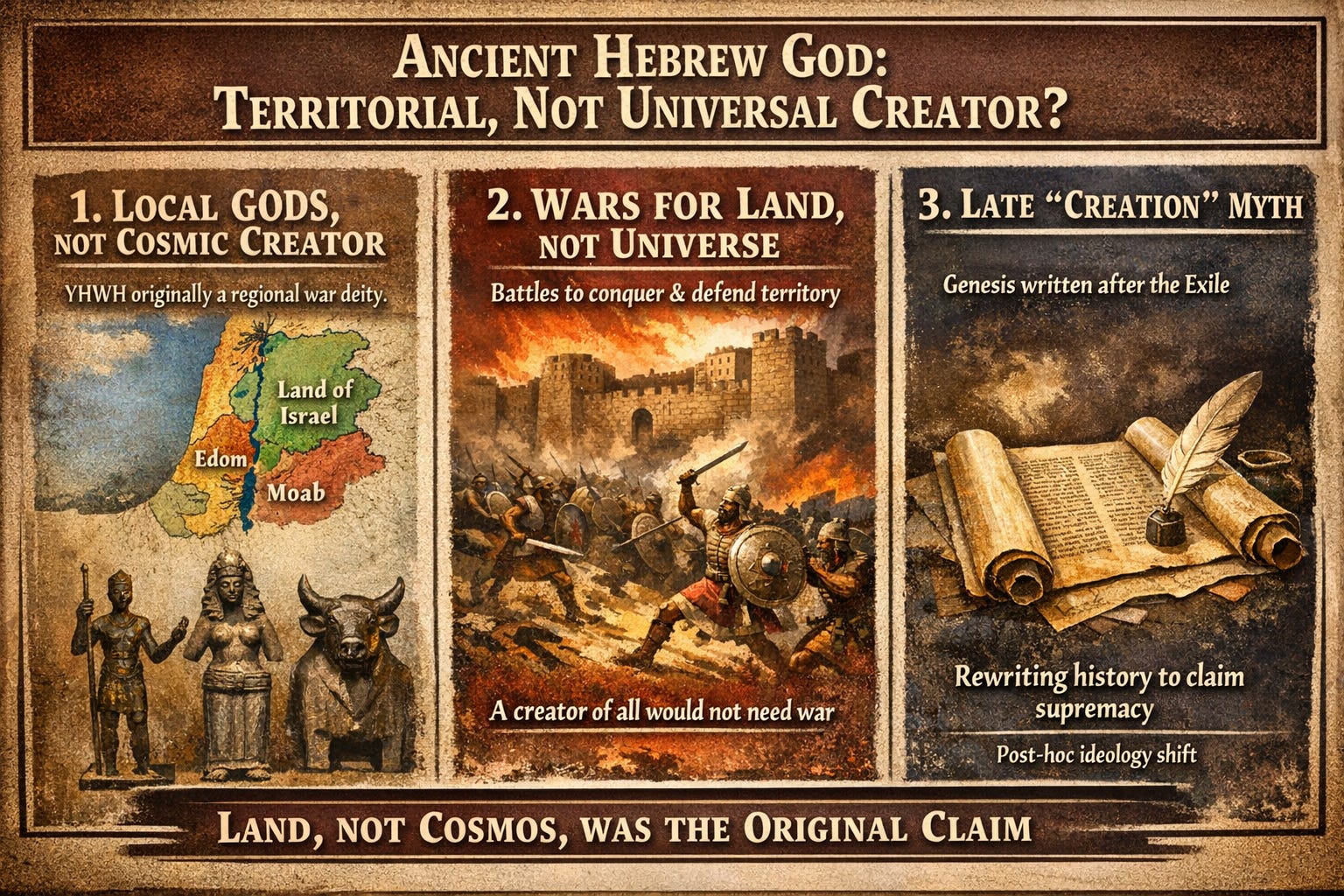
I have researched this topic ad nauseam, and even given much deference to the “emotional, religious arguments.” However the facts unveil themselves. I have condensed this issue into the following reports that detail the transition from the worship of many deities into the worship of, “the one they chose.” They are here:
From Polytheism to Monotheism: Jurisdiction, Redaction, and the Legal Construction of Biblical Exclusivity
A Law Review–Style Article
Abstract
This Article argues that biblical monotheism was not an original theological condition but a later juridical and editorial construction arising from territorial governance, state centralization, and post‑exilic identity formation. Drawing upon textual criticism, archaeology, and comparative Ancient Near Eastern law‑religion systems, this study demonstrates that early Israelite religion operated under a pluralistic divine jurisdiction model comparable to other Near Eastern polities. Monotheism emerged only after successive reforms, redactions, and imperial trauma, functioning as a legal‑ideological mechanism to consolidate authority, suppress rival cults, and retroactively normalize exclusivity. The Hebrew Bible itself preserves probative evidence of this transition.
I. Introduction
Legal systems do not arise in theological vacuums. In the ancient world, law, territory, and divine authority were inseparable. This Article examines the Hebrew Bible not as a static revelation, but as a composite legal‑religious record reflecting evolving claims of jurisdiction, legitimacy, and sovereignty. Contrary to later doctrinal assertions, the textual and archaeological record demonstrates that ancient Israelite religion was initially pluralistic, regionally differentiated, and legally analogous to surrounding Canaanite and Mesopotamian systems.
The central claim advanced here is straightforward: biblical monotheism represents an achieved legal ideology rather than an original religious fact.
II. Divine Jurisdiction in the Ancient Near East
A. Territorial Gods and Legal Authority
Across the Ancient Near East, deities were understood as territorial sovereigns. Legal authority flowed from divine patronage, and gods exercised jurisdiction over specific lands and peoples. As Mark S. Smith observes, “The notion that one god ruled all peoples equally is foreign to the political theology of the Late Bronze Age” (Smith, Origins of Biblical Monotheism, 2001).
Biblical texts implicitly accept this framework. Jephthah’s statement to the Ammonites—“Will you not possess what Chemosh your god gives you?”—acknowledges Chemosh’s legitimate authority within Moab (Judg. 11:24).
B. El as High God and Juridical Allocator
Early Israelite tradition aligns with the Canaanite high god El, who functioned as creator, judge, and distributor of nations. Deuteronomy 32:8–9, as preserved in the Dead Sea Scrolls and Septuagint, states:
“When the Most High (El Elyon) divided the nations, when he fixed the boundaries of the peoples, according to the number of the sons of God; YHWH’s portion was his people.”
This passage reflects a federal divine system in which El assigns territorial jurisdictions to subordinate gods. Frank Moore Cross notes that this model mirrors Ugaritic divine administration almost precisely (Canaanite Myth and Hebrew Epic, 1973).
III. YHWH as a Regional Deity and Later Supremacy Claim
A. Southern Origins and Martial Character
YHWH appears textually as a southern warrior deity emerging from Edom, Seir, and Midian (Deut. 33:2; Judg. 5:4). Habakkuk describes YHWH’s arrival as a storm‑theophany from Teman, language consistent with regional war gods rather than universal creators (Hab. 3:3).
John Day concludes that YHWH “was not originally identical with El but was assimilated to El’s position over time” (Yahweh and the Gods and Goddesses of Canaan, 2000).
B. Merger, Not Revelation
The fusion of El and YHWH represents theological consolidation rather than primordial unity. Titles such as El Shaddai and El Elyon persist as linguistic fossils of this merger. The later claim that YHWH was always the sole deity reflects retroactive harmonization rather than historical continuity.
IV. Competing Cults, Due Process, and Suppression
A. Asherah and Household Religion
Archaeological inscriptions from Kuntillet ʿAjrūd and Khirbet el‑Qom explicitly reference “YHWH and his Asherah,” establishing that divine plurality existed even within official YHWH worship (Dever, Did God Have a Wife?, 2005).
The subsequent destruction of Asherah poles (2 Kgs. 23:6–7) constitutes religious suppression through state power, not correction of an aberration.
B. Baal, Rival Lords, and Legal Polemic
The Baal narratives, particularly 1 Kings 18, function as polemical litigation texts. Elijah’s challenge is not metaphysical but juridical: whose god has standing to rule Israel. The need for such trials presupposes the perceived legitimacy of rival gods.
V. Centralization Reforms as Legal Reorganization
A. Hezekiah and Josiah
The reforms of Hezekiah and Josiah dismantled regional shrines, centralized sacrificial authority, and criminalized alternative cults (2 Kgs. 18; 22–23). These acts parallel legal centralization reforms seen in Assyrian vassal administration.
Richard Elliott Friedman notes that the Deuteronomistic editors “rewrote Israel’s past to reflect the reforms they sought to impose” (Who Wrote the Bible?, 1987).
B. Redaction as Retroactive Legislation
Earlier pluralistic practice was reclassified as apostasy, transforming normative behavior into legal violation. This mirrors ex post facto regulation in secular legal systems.
VI. Exile, Trauma, and the Invention of Exclusivity
A. Jurisdiction Without Territory
The Babylonian Exile invalidated territorial theology. In response, YHWH was reconceived as universal and exclusive. Isaiah declares:
“I am YHWH, and there is no other” (Isa. 45:5).
This assertion represents a jurisdictional expansion necessitated by political collapse.
B. Monotheism as Identity Law
Post-exilic monotheism functioned as a legal boundary, preventing assimilation and preserving communal coherence. Smith concludes that monotheism was “a strategy of survival” rather than inherited belief (Smith, 2001).
VII. Cosmology, Creation Claims, and the Limits of Ancient Divine Authority
A. Territorial Gods and the Absence of Universal Creation
The historical and textual record outlined above directly undermines any claim that the Israelite god was originally conceived as the creator of the universe in a metaphysical or cosmological sense. In the Ancient Near East, gods did not derive legitimacy from universal creation but from territorial control, military success, and land allocation. Creation myths functioned as charters of authority over specific domains, not as scientific or philosophical accounts of cosmic origins.
YHWH’s earliest portrayals align with this model. He is introduced not as a cosmic architect, but as a regional warrior-deity who marches from the south to claim land (Deut. 33:2; Judg. 5:4–5). His power is demonstrated through conquest, weather manipulation, and battlefield intervention—not through the creation ex nihilo of the universe.
B. Creation Language as Political Retrojection
The attribution of universal creation to YHWH appears late and coincides with the collapse of Israel’s territorial sovereignty. Only after the Babylonian Exile do biblical texts assert that YHWH alone created the heavens and the earth (Isa. 40–48). This theological expansion mirrors the loss of land-based jurisdiction: when territorial power failed, divine authority was universalized.
As Mark S. Smith explains, “Monotheism involved redefining older functions of the gods, including creation, in order to assert YHWH’s supremacy in the absence of political independence” (Origins of Biblical Monotheism, 2001).
Genesis 1 itself bears clear Mesopotamian influence, paralleling the Enuma Elish. Its function is legal-theological: to establish YHWH’s supremacy over rival gods by absorbing their cosmic roles, not to preserve an ancient, continuous belief in universal creation.
C. Hebrew Wars as Evidence of Limited Divine Jurisdiction
If YHWH were originally understood as the creator and ruler of the universe, the narrative emphasis on land seizure, boundary disputes, and tribal warfare would be incoherent. Yet the Hebrew Bible repeatedly frames divine authority as contingent upon territorial possession:
“Go in and take possession of the land that YHWH swore to your ancestors” (Deut. 1:8).
Military success validates divine favor; defeat signals divine withdrawal (Judg. 2:14–15). This is the logic of a land-bound deity, not a universal creator.
The wars against Canaanite peoples are therefore not incidental but foundational. They demonstrate that YHWH’s authority was historically asserted through conquest and inheritance, consistent with Ancient Near Eastern gods who gained prestige by expanding their people’s territory.
D. Logical Incompatibility with Universal Creation Claims
The claim that a god created the universe presupposes pre-existence, omnipotence, and non-contingent authority. None of these attributes characterize YHWH in the earliest biblical layers. Instead, YHWH:
Competes with other gods
Loses battles (Judg. 1:19)
Requires territorial loyalty
Depends on cultic maintenance
Such characteristics are incompatible with a being understood as the timeless creator of all reality.
Universal creation theology emerges only after rival gods are demoted rhetorically, not historically eliminated. This is theological inflation, not original ontology.
E. Conclusion: Creation Claims as Post-Hoc Ideology
The evidence supports a clear conclusion: claims that the Hebrew god created the universe are late, compensatory theological assertions developed after military defeat, exile, and loss of land-based legitimacy.
The historical reality preserved in the Hebrew Bible is one of competing gods, contested territories, and jurisdictional struggle. Creation language functions as a retroactive ideological tool designed to elevate a formerly regional god into a universal sovereign once empirical authority had failed.
Accordingly, appeals to ancient belief in a universe-creating Hebrew god are not supported by history, archaeology, or the earliest biblical texts, and are directly contradicted by the land-centered wars that defined Israel’s religious origins.
VII. Genesis, Exile, and the Enuma Elish: Creation as Post-Imperial Legal Theology
A. The Enuma Elish as Imperial Charter
The Enuma Elish, the Babylonian creation epic recited during the Akitu (New Year) festival, functioned as an imperial legal charter. It did not merely describe cosmic origins; it legitimized Babylonian political dominance and Marduk’s supreme authority. Creation in Mesopotamian thought was inseparable from kingship, law, and empire.
The epic culminates in Marduk’s elevation after defeating Tiamat, followed by the bestowal of the Tablet of Destinies—a legal symbol of cosmic jurisdiction. As scholars widely agree, the Enuma Elish establishes divine supremacy through conquest and reordering, not philosophical abstraction (Dalley, 2000).
B. Structural and Linguistic Parallels with Genesis 1
Genesis 1 mirrors the structure and logic of the Enuma Elish while stripping it of overt polytheism. Key parallels include:
Primordial waters (tehom / Tiamat)
Creation through divine speech
Sequential ordering of chaos into cosmos
Creation as legitimization of authority
The Hebrew tehom is linguistically cognate with Tiamat, demonstrating literary dependence rather than coincidence. Genesis adopts the imperial logic of Babylonian cosmology but reallocates supremacy to YHWH.
Mark S. Smith observes:
“Genesis 1 represents a demythologized but not desacralized version of Mesopotamian cosmology, refashioned for Israel’s post-exilic needs.”
C. Counter-Imperial Adaptation, Not Ancient Revelation
Genesis is best understood as counter-imperial literature. Written in the shadow of Babylonian dominance, it answers the Enuma Elish by asserting that YHWH—not Marduk—is the true cosmic sovereign. This move universalizes YHWH precisely when Israel lacks land, king, and temple.
Crucially, this theology appears only after exposure to Babylonian imperial ideology. There is no evidence of such universal creation claims in pre-exilic Israelite religion.
D. Creation as Retroactive Jurisdictional Claim
By asserting that YHWH created the heavens and the earth, Genesis retroactively nullifies all rival divine jurisdictions. In legal terms, it asserts original title after dispossession. Earlier territorial gods—El, Baal, Chemosh—are rendered illegitimate not by historical displacement, but by narrative redefinition.
This is not continuity; it is revision.
E. Hebrew Wars and the Contradiction of Early Creation Claims
The conquest narratives of Joshua and Judges presuppose a god whose authority is validated through land acquisition and military success. Such narratives are logically incompatible with an already-universal creator deity.
If YHWH were always understood as creator of the universe, the obsession with borders, inheritance, and defeat would be unnecessary. The historical record instead supports a theology that evolved from land-based jurisdiction to cosmic abstraction.
VIII. Conclusion
The Hebrew Bible does not testify to primordial monotheism or original belief in a universe-creating deity. Instead, it documents a progression from territorial polytheism to post-exilic universalism driven by political collapse and redactional strategy. Genesis, shaped in dialogue with the Enuma Elish, represents a late-stage ideological reconstruction designed to replace lost land with absolute cosmological authority.
What remains is not evidence of timeless revelation, but of historical adaptation, legal retrojection, and theological inflation following imperial defeat.
References (Additional)
Dalley, S. (2000). Myths from Mesopotamia. Oxford University Press.
Smith, M. S. (2010). The Priestly Vision of Genesis 1. Fortress Press. (finis)
///
The Evolution of Deity Worship in Ancient Israel Expanded Academic Report on Sections 2, 3, 4, and 6
Abstract
This report expands upon the historical, textual, and archaeological evidence demonstrating that ancient Israelite religion did not originate as strict monotheism, but rather evolved through identifiable stages of polytheism, henotheism, and monolatry before arriving at post‑exilic monotheism. By expanding Sections 2, 3, 4, and 6, this study situates Hebrew religious development within its broader Ancient Near Eastern context and relies upon biblical textual criticism, comparative Semitic religion, epigraphy, and archaeology. Citations are provided to peer‑reviewed scholarship and primary sources.
Section 2 (Expanded): Distinct Deities by Function, Geography, and Era
2.1 Regionalism and Divine Jurisdiction
Ancient Near Eastern religions were fundamentally territorial and functional. Deities were understood to possess jurisdiction over specific lands, peoples, and natural forces. Early Israelite religion followed this norm. Biblical texts consistently assume that other nations possessed their own legitimate gods (e.g., Judges 11:24; 2 Kings 3:27), contradicting later universalist monotheism.
The idea of a single, omnipresent deity was foreign to the Late Bronze and early Iron Age Levant. Instead, gods were geographically embedded, and divine power was linked to land tenure, military success, and fertility cycles (Smith, 2001).
2.2 El as the Original High God
The earliest strata of Hebrew tradition align closely with the Canaanite high god El, known from Ugaritic texts as the aged creator, judge, and father of the gods. Patriarchal narratives preserve El‑based titles:
El Elyon (Genesis 14:18–22)
El Shaddai (Genesis 17:1)
El Olam (Genesis 21:33)
These titles predate the nationalization of YHWH and indicate that Israel originally identified with El rather than YHWH (Cross, 1973). Linguistically and functionally, El and YHWH were distinct before later theological fusion.
2.3 YHWH as a Southern Warrior Deity
YHWH emerges later as a southern, storm‑war deity, associated with Edom, Seir, Paran, and Midian (Deuteronomy 33:2; Judges 5:4–5; Habakkuk 3:3). This geographic origin places YHWH outside early Canaanite urban centers and supports the hypothesis that YHWH was adopted into Israelite religion rather than originating within it.
Early YHWH traditions emphasize military theophany, storm imagery, and battlefield dominance—traits typical of regional warrior gods (Day, 2000).
2.4 Asherah and Domestic Religion
Asherah functioned as a divine consort and household goddess, essential to fertility, childbirth, and family continuity. Archaeological evidence—including pillar figurines and inscriptions from Kuntillet ʿAjrūd and Khirbet el‑Qom—explicitly reference “YHWH and his Asherah” (Dever, 2005).
The persistence of Asherah worship demonstrates that official temple theology diverged sharply from lived religion. Her later removal reflects political and priestly consolidation, not original belief.
Section 3 (Expanded): Textual Evidence for Multiple Deities
3.1 Deuteronomy 32 and Divine Allocation
The oldest textual witnesses (Dead Sea Scrolls and Septuagint) preserve a reading of Deuteronomy 32:8–9 in which El Elyon assigns nations to the sons of God, with YHWH receiving Israel as his allotment. This cosmology presumes a pantheon governed by El, directly contradicting later Masoretic revisions (Tigay, 1996).
3.2 Psalm 82 and the Divine Council
Psalm 82 depicts God standing in the divine council (ʿadat ʾel) and judging other gods (elohim). This scene parallels Ugaritic council imagery and reflects a polytheistic framework later reinterpreted allegorically (Parker, 1997).
3.3 Linguistic Plurality of Elohim
The Hebrew term elohim is grammatically plural and is used for:
YHWH
Foreign gods
Divine beings
Spirits of the dead (1 Samuel 28:13)
This linguistic flexibility reflects an inherited polytheistic worldview rather than philosophical monotheism.
Section 4 (Expanded): Centralization and Theological Consolidation (c. 700–500 BCE)
4.1 Political Reforms and Religious Control
The reforms of Hezekiah and Josiah sought to centralize worship in Jerusalem, eliminate regional shrines, and suppress non‑YHWH cults (2 Kings 18; 2 Kings 22–23). These reforms were as much political as theological, consolidating royal authority through cultic uniformity.
4.2 Redaction and Historical Revision
Deuteronomistic editors retrojected exclusive YHWH worship into earlier periods, producing narratives in which deviation appears as apostasy rather than norm. This process involved:
Reframing rival gods as false
Erasing divine consorts
Recasting Israelite history as a cycle of sin and reform
Such redaction is well‑documented in comparative textual criticism (Friedman, 1987).
Section 6 (Expanded): Exile, Trauma, and the Finalization of Monotheism
6.1 The Babylonian Exile as Theological Catalyst
The destruction of Jerusalem (586 BCE) created a crisis: territorial gods were expected to fail outside their land. In response, Israelite theology universalized YHWH, redefining him as transcendent, omnipotent, and exclusive (Isaiah 45:5–7).
6.2 Monotheism as Identity Reconstruction
Post‑exilic monotheism functioned as a survival strategy, preserving identity without land, king, or temple. The denial of other gods served to:
Reinforce communal boundaries
Prevent religious assimilation
Legitimize priestly authority
This form of monotheism is historically contingent, not primordial.
Section 6.3 Bottom Line (Expanded Conclusion)
The evidence demonstrates that:
Early Israelite religion was plural and regionally diverse
YHWH was not originally the sole or supreme deity
Monotheism emerged through political trauma and editorial control
The Hebrew Bible preserves traces of earlier polytheism despite later revision
Thus, biblical monotheism represents an achieved ideology, not an ancestral constant.
References
Cross, F. M. (1973). Canaanite Myth and Hebrew Epic. Harvard University Press.
Day, J. (2000). Yahweh and the Gods and Goddesses of Canaan. Sheffield Academic Press.
Dever, W. G. (2005). Did God Have a Wife? Archaeology and Folk Religion in Ancient Israel. Eerdmans.
Friedman, R. E. (1987). Who Wrote the Bible? HarperCollins.
Parker, S. B. (1997). Ugaritic Narrative Poetry. Scholars Press.
Smith, M. S. (2001). The Origins of Biblical Monotheism. Oxford University Press.
Tigay, J. H. (1996). Deuteronomy. JPS Torah Commentary. (finis)
Special Thanks to Stephan’s History of the World https://www.youtube.com/@Stephans_History_of_the_World
At the distilled essence all of the religious “stuff” is just another distraction with a phony divinity twist. I mean, it is manifest that most people have no idea about what it is that they say they worship. I believe in the faith of people, “their faith energy” is sincere, however I believe it is being “siphoned off and diverted” towards the very things that preclude people from connecting from the The Source of Creation that they have faith in via an obscure form. See, I have never confused “faith” with religion. Let me explain.
Faith, any faith that is positive, any faith that recognizes The Source of Creation, creates a resonance in the hearts of those who have such, and the truth of this is expressed tangibly in their Good character and deeds. That is the Universal “religion.” It is not predicated upon any books, any mouthpieces, any rituals, or any thing except Goodness. Yes, traditions help us achieve that goal, they give us rituals, but do they “originate faith?” Where is faith housed? At the church? In someone else’s mouth? In the heart it is found.
Yes, wise words found in the traditions of all “faiths” can guide us along the way, “But not if we don’t know them.” When we don’t know “them,” there is no telling what Pastor Pork Chop and company have in store for us. They’ll “try to” have us worshipping the devil, and in many they may have succeeded.
Lord have Mercy
A lot of clarity. TY
I see there was a Moab south of Israel. Do you know how this relates to Moab, Utah & the mormon cult?