
The Scapegoat
U.S.S. Indianapolis Disaster

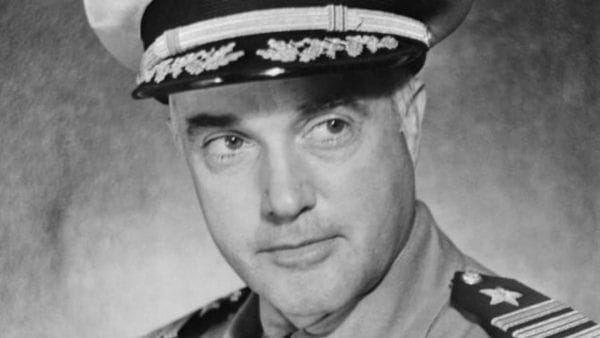
I often wonder how many scapegoats will history unveil that were associated with the current conflict with Iran. I mean, as evidenced it has been one debacle after another that indicates nothing short of a loss, both in actuality, but also in realm stature. I don’t believe this conflict is over, however whenever it finally is, there are going to be some people that are going to have to “ride that.” Someone is going to have to be the public face on “the deficits.” This is how “that game” goes. Nobody ever wants to ride the horse that is losing, and when it does anyone associated with the horse is blamed, except the owner. The trainer, the stableman, the doctor, all and sundry, just not the owner who put the “outmatched horse” in the race. Never that.
The owner of the horse will blame everyone, except himself. Arrogance and pride won’t allow that. Arrogance and pride was what made the owner match his mule with a line of quarter horses. Arrogance and pride made the owner believe he could win. When the owner lost, it became “everyone else’s” fault, and in that “fault” a scapegoat was, and is, created. History evidences this fact. The future will too.
“Charles McVay is most known in U.S. naval history for captaining USS Indianapolis (CA-35) when two Japanese torpedoes from submarine I-58 struck and sunk her on 30 July 1945. Survivors of the sinking drifted unknown in the Philippine Sea for four days and 880 sailors out of a crew of 1,196 were lost. The loss of the Indianapolis, and failure of the Navy to recognize its non-arrival in port, remains one of the most tragic episodes in U.S. Naval history. Captain McVay was court-martialed in the aftermath of the sinking and found guilty of recklessly endangering his crew by failing to zig-zag, in spite of I-58 Captain Mochitsura Hashimoto’s testimony at the trial stating that such maneuvers would not have changed the outcome of his attack. The conviction effectively ruined McVay’s career. It was controversial at the time and remains so today. McVay had a distinguished naval career prior to the loss of Indianapolis. He served as Executive Officer of the USS Cleveland (CL-55) during the North African landings in November 1942 and earned a Silver Star for his actions aboard the same ship in the Solomon Islands in March 1943. From May 43-October 44, McVay chaired the Joint Intelligence Staff in Washington DC. He took command of Indianapolis on 18 November 1944. Under his command, Indianapolis participated in attacks on Iwo Jima, Tokyo, and was critically damaged by a kamikaze in the pre-invasion of Okinawa. After refitting in Mare Island, California, Indianapolis delivered the components of the atomic bomb to Tinian. She was sunk on her return to the Pacific Theater for the staging of an invasion of mainland Japan following this mission. McVay died on 6 November 1968. Secretary of Navy Gordon England ordered that a letter expressing Congressional exoneration of McVay be placed in his official file in 2001.
https://www.history.navy.mil/research/histories/biographies-list/bios-m/mcvay-charles-b-iii.html
What fascinates me about this topic is how Captain Mc Vay III was railroaded out of his commission. The direct testimony of the Japanese Captain of the submarine who sank the U.S.S. Indianapolis confirmed that “nothing was stopping him from sinking the ship.” That included evasive actions. Apparently, that did not matter. Someone had to “ride that,” and that was Captain Charles B. Mc Vay III. My report on this incident is here:
The USS Indianapolis Disaster and the Court-Martial of Captain Charles B. McVay III:
A Naval Catastrophe, Institutional Negligence, and the Scapegoating of a Commanding Officer
Abstract
The sinking of the USS Indianapolis (CA-35) on July 30, 1945, remains one of the most catastrophic naval disasters in United States military history. After completing a classified mission delivering components of the atomic bomb “Little Boy,” the cruiser was torpedoed by the Imperial Japanese submarine I-58 in the Philippine Sea. Of approximately 1,195 crewmen aboard, only 316 survived after enduring four days in open water under conditions of dehydration, exposure, delirium, and shark predation.
This report examines the disaster through historical, legal, and military lenses, focusing particularly on the controversial court-martial of Captain Charles Butler McVay III. It argues that McVay was used as a scapegoat to deflect scrutiny from systemic failures by the U.S. Navy, including intelligence lapses, denial of escort, communication breakdowns, and delayed rescue. Particular attention is given to the extraordinary role of Japanese submarine commander Mochitsura Hashimoto, whose testimony for the defense directly contradicted the prosecution’s theory. Despite this, McVay was convicted of “hazarding his ship” by failing to zigzag—a conviction later widely regarded as a miscarriage of justice.
I. Historical Background
A. The Secret Atomic Mission
The USS Indianapolis, a Portland-class heavy cruiser, was selected in July 1945 to transport critical components of the first operational atomic bomb.
Cargo included:
uranium-235 components for “Little Boy”;
bomb initiator mechanisms;
classified assembly materials.
The ship traveled:
San Francisco → Pearl Harbor
Pearl Harbor → Tinian Island
The Indianapolis set a speed record for portions of the trip.
Historian Richard Newcomb wrote:
“The Indianapolis had carried perhaps the most consequential cargo in naval history.”
(Abandon Ship!, 1958)
After unloading cargo at Tinian, the ship sailed toward Leyte via Guam.
II. The Sinking
A. Attack by I-58
At approximately 12:15 a.m. on July 30, 1945, the Japanese submarine I-58, commanded by Commander Mochitsura Hashimoto, fired six Type 95 torpedoes.
Two struck:
one near the bow;
one amidships near fuel and powder storage.
Hashimoto later wrote:
“The cruiser was silhouetted clearly against the horizon.”
(Sunk: The Story of the Japanese Submarine Fleet, 1954)
The vessel sank in approximately 12 minutes.
B. Casualties
Of roughly 1,195 aboard:
~300 died immediately;
~890 entered the sea;
316 survived.
Approximately 879 perished.
III. Survival Ordeal
Survivors endured:
1. Dehydration and Saltwater Poisoning
Drinking seawater caused psychosis, renal failure, and hallucinations.
2. Exposure
Extreme ultraviolet exposure by day; hypothermia at night.
3. Shark Predation
Oceanic whitetip sharks (Carcharhinus longimanus) and tiger sharks were reported.
Survivor accounts describe repeated attacks.
IV. Institutional Negligence by the U.S. Navy
A. Denial of Escort
McVay requested escort protection.
The Navy denied it.
Despite known submarine activity in the route area.
B. Intelligence Failures
The Navy possessed intelligence that enemy submarines were active nearby.
McVay reportedly was not informed.
This raises questions under military duty-of-care principles.
C. Failure to Track Movement Reports
The Movement Report System failed.
No one noticed the ship had not arrived.
Multiple distress signals were allegedly received but not acted upon.
Accounts indicate:
one officer dismissed it as deception;
one was sleeping;
one delayed action.
Historian Doug Stanton wrote:
“The Navy knew enough to save many more men.”
(In Harm’s Way, 2001)
V. The Court-Martial of Captain McVay
A. Charges
McVay was charged with:
1. Failure to Order Abandon Ship
He was acquitted.
Evidence showed the rapid sinking made orderly abandonment nearly impossible.
2. Hazarding His Ship by Failing to Zigzag
He was convicted.
The Navy argued zigzagging would have reduced vulnerability.
VI. The Legal Theory of “Hazarding a Ship”
Under Articles for the Government of the Navy, “hazarding” involves negligence or misconduct exposing a vessel to danger.
The prosecution argued:
McVay stopped zigzagging;
conditions still permitted visibility;
zigzagging could have prevented attack.
The defense argued:
zigzagging was discretionary;
weather and visibility were poor;
zigzagging would not have changed the outcome.
VII. Commander Hashimoto’s Testimony
One of the most extraordinary aspects of the trial was the appearance of enemy commander Mochitsura Hashimoto.
He testified for the defense.
Hashimoto stated:
“I would have made a successful attack regardless of whether your ship had been zigzagging.”
This statement directly undercut causation.
In criminal or quasi-criminal legal analysis, causation is essential.
If the same result would have occurred regardless of the accused’s conduct, proximate causation is undermined.
Despite this testimony, McVay was convicted.
VIII. Scapegoating and Political Motive
A. Protection of Navy Leadership
The Navy faced embarrassment due to:
intelligence suppression;
lack of escort;
ignored distress signals;
delayed rescue.
Charging McVay redirected public blame.
B. Secrecy of Atomic Mission
The atomic mission remained classified.
The Navy could not fully explain routing decisions.
This likely distorted the legal process.
C. Public Pressure
Families demanded accountability.
The Navy produced an identifiable defendant.
McVay became the symbolic target.
IX. Due Process Concerns
Several issues remain troubling:
Selective Prosecution
McVay was the only U.S. Navy captain court-martialed for losing a ship to enemy action during WWII.
Ignoring Exculpatory Evidence
Hashimoto’s testimony created reasonable doubt.
Command Influence
Military justice is susceptible to unlawful command influence.
Political pressure may have influenced proceedings.
X. Sentence and Career Destruction
McVay’s sentence:
loss of 100 numbers in seniority;
formal conviction.
Admiral Chester Nimitz later remitted the sentence.
But the conviction remained.
McVay retired in 1949.
He received hate mail for years.
On November 6, 1968, he died by suicide.
XI. Exoneration
Survivors sought justice for decades.
A schoolboy researcher, Hunter Scott, revived public attention in the 1990s.
In 2000:
Congress passed a resolution clearing McVay.
The Navy formally exonerated him in 2001.
Congress found:
“The sinking of the USS Indianapolis was not the fault of Captain McVay.”
XII. Legal and Historical Implications
This case remains a study in:
A. Scapegoating in Bureaucracies
Organizations often isolate blame to preserve institutional legitimacy.
B. Military Due Process Failures
Exculpatory evidence may be minimized.
C. Causation in Command Liability
Hashimoto’s testimony undermined legal causation.
D. Institutional Negligence
Systemic failure exceeded individual fault.
Conclusion
The USS Indianapolis disaster was not merely a wartime tragedy—it was a compounded catastrophe involving combat loss, institutional incompetence, delayed rescue, and legal scapegoating.
Captain Charles B. McVay III became the face of failures he did not create.
The extraordinary intervention of Commander Mochitsura Hashimoto exposed weaknesses in the prosecution’s case, yet politics prevailed over fairness.
McVay’s later exoneration underscores a historical truth:
the Navy’s need to preserve institutional credibility outweighed justice.
The case remains a profound example of command scapegoating and the dangers of politically influenced military justice.
References
Newcomb, Richard F. Abandon Ship! (1958).
Stanton, Doug. In Harm’s Way (2001).
Hashimoto, Mochitsura. Sunk: The Story of the Japanese Submarine Fleet (1954).
U.S. Congressional Record, 2000 Resolution.
U.S. Navy JAG records.
Articles for the Government of the Navy (pre-UCMJ).
National WWII Museum archives.
Naval History and Heritage Command. (finis)
[Congressional Record (Bound Edition), Volume 147 (2001), Part 10] [House] [Page 14817]
[From the U.S. Government Publishing Office, www.gpo.gov]
[[Page 14817]]
EXONERATION OF CAPTAIN CHARLES B. McVAY III
The SPEAKER pro tempore. Under a previous order of the House, the gentlewoman from Indiana (Ms. Carson) is recognized for 5 minutes.
Ms. CARSON of Indiana. Mr. Speaker, I am pleased to call to the attention of the House of Representatives a decision by the Department of the Navy that exonerates the late Charles Butler McVay III, captain of the heavy cruiser, the USS Indianapolis who was court-martialed and convicted 56 years ago after his ship sank in the closing days of World War II.
The survivors of that tragedy, Mr. Speaker, have relentlessly sought to have Captain McVay vindicated; and those who remain are relieved by the Navy’s long-delayed yet justifiable decision.
On May 14, 1999, I ushered an 11-year-old student from Florida to drop H.J. Res. 48 into the system for consideration by the House.
Hunter Scott went to a movie in Pensacola, Florida, and saw Jaws, in which there was a brief soliloquy about the sinking of the USS Indianapolis. Hunter’s interest in the ship’s disaster was the beginning of a school history project, trips to Washington, D.C., media attention, and an upcoming movie.
Language to exonerate Captain McVay was inserted in the Defense Authorization Act of 2001. The legislation expresses the sense of Congress that Captain McVay should be exonerated because some facts important to the case were never considered by the 1945 court-martial board. Classified data were not even made available to the board.
Survivors of the greatest sea disaster in our Navy’s history at that time sought to have their captain’s name cleared for periods that spanned several years, oftentimes efforts that drew controversy. The magnitude of the crusade was elevated by this young man’s trip to the movies, his campaign to derive justice for the captain and the crew.
Indeed, one person can make a difference.
Captain McVay’s record has been modified to reflect his exoneration, a profound tribute to the crew, myself and young Hunter Scott especially.
Of the 317 survivors of the USS Indianapolis disaster, only 120 remain alive today.
https://www.govinfo.gov/content/pkg/CRECB-2001-pt10/html/CRECB-2001-pt10-Pg14817.htm
Anyone with or without a crystal ball should be able to “read the room.” I mean, it does not take much deduction to know where “this thing” goes. A scapegoat or three will have to be blamed. That is how it goes. I mean, the “true believers” will double down, or triple down and fully commit to “whatever strategy that is losing” until they can’t anymore. When that happens then the scapegoats will “pop up.” It is the only thing that can happen. It always does, and this will not change, “this time.”
At this time there are so many potential scapegoats that it is hard to keep track of them. I mean, there are so many people fumbling and bumbling through their respective “roles in this thing” that there is a large pool of candidates just awaiting “their turn.” What I can say is this, “I don’t know who will be the next scapegoat will be, but I do know who it won’t be. That person is here:
Stay tuned. Scapegoats are incoming. Many of them. This is how history works. Think about it? Each historical account has “someone to blame” baked right in. It’s always a singular villain or dummy, depending on the circumstances. “It was Hitler,” they insist, and it was. “Stalin too,” however it was a lot of people in conjunction with each other. Each an extremity of the same evil entity. Hitler and Stalin had their scapegoats, those that they blamed for failure, in the same way that others after them will. It’s a natural thing. Children blame others regularly, until taught otherwise.
Losses generate scapegoats regularly, because the owner is never at fault, and never will be. See, in history, those in position of rule have always had “brilliant plans” that they implemented to a failure. Think about it? How many times throughout the historical record has a “brilliant plan,” supported by sycophants, failed? How many armies destroyed or battles lost because a king or commander “had a bright idea?”
Is history supposed to stop? Are “bright ideas” supposed to just vanish from the minds of people in positions of rule? Are natural courses of blundering supposed to stop “in this time line?” Nope, and since “brilliant plans and bright ideas” are not going anywhere, when they fail, they are going to need a scapegoat to “ride that.”
Lord have Mercy
Awesome article and it’s always someone lower on the totem pole , mariner’s law would be a good article cuz not much has changed since the wooden boat days
Nothing ever changes during the bp disaster and being a captain I blew an outboard engine and spent almost all night putting on another one so I could run the next day and it threw a rod so I had to fill out two USCG incident reports for both engines nobody was in danger I had three engines on the back