
Voting for Dollars
Literally

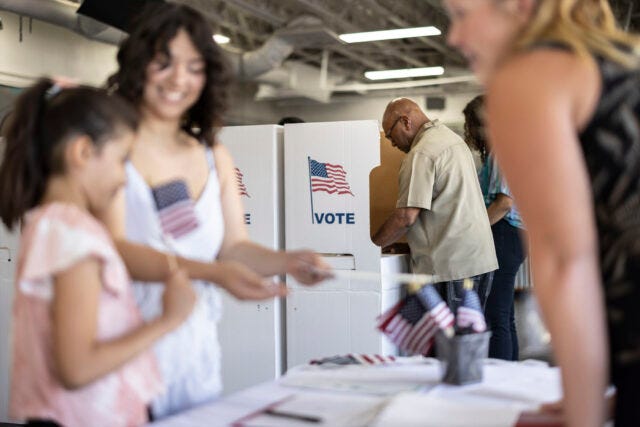
Some people of the states united have their feathers ruffled as high as they can go, and it has to do with the recent Supreme Court decision that they feel is somehow denying them rights and immunities that they are entitled to. One of them being the right to representation by the candidate of their choice through voting. Some feel this “right” is somehow effected by district lines, and others feel the polar opposite. I feel like none of it matters either way, simply because “voting” has taken the people of this land to the point where they are right now. “Voting,” only works when the “voters” are well educated about who they are voting for, and most people aren’t. People vote personality and propaganda. Nothing else.
The Negros, and others are upset that the recent Supreme Court decision “appears” to discriminate against them. It is the usual “racial outrage,” but in the overall spectrum of things it is meaningless. Racial “anything” has nothing to do with the Supreme Court decision, it was a simple matter of “equal protection.” Meaning, “everyone being treated the same.” That means without racial preference.
The reason why this is important is because the decision utilized some very curious wording. Words that some may not even alert to. Words like, “non-African American.” See, most people are not familiar with census records, or the way that race is distinguished therein. I am, and since I am I will start with the word, “non.” “Non,” meaning, “not.” Or in French, “No.”
Africa is a continent. A person’s “nationality” cannot be distinguished from “a continent,” but rather a nation or land on that continent. Ask a person from Africa where they are from and they reply, “Angola, Nigeria, Ivory Coast, etc.” So, a person from “Africa” is “stateless.” He or she can claim no nationality. It is the same with “American.” There are three Americas, to wit, “North, Central and South.” So, a person that is an “American” is again “stateless too.” People born in the “states united” have state birth records, not “American” ones. So, a “African-American” is a “double” stateless classification, and not a racial identifier. A person from Africa, or a descendant of a slave, they have no standing on this land. In the same way that most immigrant groups don’t.
It [CONSTITUTION] then proceeds to say: “We hold these truths to be self-evident: that all men are created equal; that they are endowed by their Creator with certain unalienable rights; that among them is life, liberty, and the pursuit of happiness; that to secure these rights, Governments are instituted, deriving their just powers from the consent of the governed. The general words above quoted would seem to embrace the whole human family, and if they were used in a similar instrument at this day would be so understood. But it is too clear for dispute, that the enslaved African race were NOT intended to be included, and formed NO part of the people who framed and adopted this declaration; for if the language, as understood in that day, would embrace them, the conduct of the distinguished men who framed the Declaration of Independence would have been utterly and flagrantly inconsistent with the principles they asserted; and instead of the sympathy of mankind, to which they so confidently appealed, they would have deserved and received universal rebuke and reprobation.”
http://www.loc.gov/resource/llst.022 The Dred Scott decision
“Updated on April 29 at 9:58 p.m. -The Supreme Court on Wednesday, in the case of Louisiana v. Callais, struck down a Louisiana congressional map that a group of voters who describe themselves as “non-African American” had challenged as the product of unconstitutional racial gerrymandering. By a vote of 6-3, the justices left in place a ruling by a federal court that barred the state from using the map, which had created a second majority-Black district, in future elections. Although Wednesday’s ruling did not strike down a key provision of the federal Voting Rights Act, as Louisiana and the challengers had asked the court to do, Justice Elena Kagan suggested in her dissent (which was joined by Justices Sonia Sotomayor and Ketanji Brown Jackson) that the majority opinion by Justice Samuel Alito had rendered the provision “all but a dead letter.”
“The decision was the latest, and presumably final, chapter in a long-running dispute arising from Louisiana’s efforts to adopt a new congressional map in the wake of the 2020 census. The first map that the state adopted, in 2022, had one majority-Black district out of the six allotted to the state. A group of Black voters – who comprise roughly one-third of the state’s population – went to federal court, where they alleged that the map violated Section 2 of the VRA, which prohibits discrimination in voting.”
“A federal judge agreed that the 2022 map likely violated Section 2, and the U.S. Court of Appeals for the 5th Circuit upheld that ruling. It instructed Louisiana to draw a new map by January 2024 or risk having the court adopt one for it. The map that Louisiana drew in 2024 created a second majority-Black district, leading to the election in November of that year of Cleo Fields, a former member of Congress who had represented another majority-Black district during the 1990s.”
“The map also prompted the lawsuit leading to Wednesday’s opinion. It was filed by a group of “non-African American” voters who contended that the 2024 map violated the Constitution’s equal protection clause by sorting voters based on race. A three-judge federal district court agreed with them and barred the state from using the 2024 map in future elections, but a divided Supreme Court temporarily paused that ruling in May 2024.”
“The Supreme Court took up the case and heard oral arguments for the first time in March 2025. Defending the 2022 map, Louisiana contended that once the lower courts determined that the 2022 map was likely invalid and ordered it to adopt a new map with a second majority-Black district, its focus was not on race but on creating a map that would protect the state’s powerful Republican incumbents in Congress, such as Speaker of the House Mike Johnson and Rep. Julia Letlow, who sits on the House Appropriations Committee.”
“The “non-African American” voters challenging the 2024 map told the justices that it was “utterly implausible” that both race and politics were equally responsible for the 2024 map.”
https://www.scotusblog.com/2026/04/in-major-voting-rights-act-case-supreme-court-strikes-down-redistricting-map-challenged-as-racia/
Portions of the Supreme Court decision are here:
LOUISIANA v. CALLAIS Syllabus
Held: Because the Voting Rights Act did not require Louisiana to create an additional majority-minority district, no compelling interest justified the State’s use of race in creating SB8, and that map is an unconstitutional racial gerrymander. Pp. 17–36.
(a) The Constitution almost never permits a State to discriminate on the basis of race, and such discrimination triggers strict scrutiny. The Court’s precedents have identified “only two compelling interests” that can satisfy strict scrutiny: “avoiding imminent and serious risks to human safety in prisons,” and “remediating specific, identified instances of past discrimination that violated the Constitution or a statute.” Students for Fair Admissions, Inc. v. President and Fellows of Harvard College, 600 U. S. 181. The question presented is whether compliance with §2 of the Voting Rights Act should be added to this very short list of compelling interests. The Court now holds that compliance with §2, as properly construed, can provide such an interest. A proper interpretation of §2 requires examining the statutory text to understand what it demands with respect to drawing legislative districts. Pp. 17–26.
(1) Under Section 2(a), the Court takes as a given that a legislative districting map may constitute a “standard, practice, or procedure” that may violate §2 if it “results in a denial or abridgement” of the right to vote “on account of race or color.” Section 2(b) establishes that a violation occurs when political processes are “not equally open to participation by” members of a racial group “in that [they] have less opportunity than other members of the electorate to . . . elect representatives of their choice.” The key concept is “less opportunity than other members of the electorate,” which sets a baseline against which to assess the opportunity of minority voters. That baseline—the opportunity that any given group of voters has to elect their candidate of choice—depends on the voting preferences of other voters in the district. For example, in a district where most voters prefer Democratic candidates, a Republican voter in that district will have a low chance of securing the election of his or her preferred candidate. The roster of voters who end up in a given district depends, in turn, on the districting criteria the State uses to draw a legislative map. Thus, the “opportunity” of these “members of the electorate” to contribute their votes to a winning cause is whatever opportunity results from the application of the State’s combination of permissible districting criteria. That is what a randomly selected individual voter and group of voters can expect regarding their opportunity to elect their preferred candidate. Under §2, a minority voter is entitled to nothing less and nothing more.”
Pp. 19–22.
https://www.supremecourt.gov/opinions/25pdf/24-109_21o3.pdf
Some people feel as if they are going to be denied the right to vote for the candidate of their choice. For the sake of argument, “How does that matter?” I mean, history evidences that NOT ONE generation of voters on this land, EVER, got the candidate that they voted for. They may have gotten “the name,” or the “suit,” but most, if not all of the campaign promises never come to fruition. Think about it?
In the 1970’s it was, “When we get these nuclear power stations up and running, electricity is gonna be so cheap that it’ll almost be free.”
In 2026 it’s, “Your gonna win so much that you get tired of winning. You’re gonna call and say, “Please Mr. President, can we stop winning now.”
Or how about, ‘Read my lips, no new taxes.”
See, most people haven’t figured out the grift. People say anything to get in, just so that they can forward “whatever agenda” that is needed, and skim a few dollars off the top. That’s it. It is literally voting for dollars, except those dollars are flowing out, and not flowing in. Dollars are flowing out, away from the people, and into the coffers and pockets of sundry nations, groups and individuals.
Negros specifically, are upset about redistricting lines. Why? What has “their current district or representative” done for their people in generations? NOTHING. How much cash over the generations went elsewhere? How many politicians that “had a chance” to make a change; and they did nothing except collect a check and whatever kickbacks they could “talk up on?” Think about how many politicians have “snookered” the people with their rhetoric, only to bring the realm “to this point?”
The Negros and others are upset. Why? I mean, it’s like a strumpet being upset that her pimp won’t abuse her for another night. It’s like the unwanted guest, who can’t “take a hint” that it’s time to go, until finally the host has them physically thrown out, and then they beat on the door trying to get back in. It is that level of “not comprehending” their predicament. Voting has never been a benefit to Negros, Indians, Latinos or poor Whites. Why? Because it does not matter who they “vote in,” they still only get a “name and a suit,” and nothing else. The agenda forward is baked right in. Somehow people can’t see that.
Lord have Mercy
I would like to introduce a concept I feel most are unaware of. Voting for people is totally meaningless. In fact takes us backward. Voting for a person means nothing because a person can change their mind as often as they wish. You may vote for x on the basis that x will cut taxes, but when x gets in, they raise taxes. They use any excuse they like, it's too late and you have to wait for 4 years before you can get another one who may do the same thing or worse. This goes on and on and the ones you give this power to know it.
The only way voting makes any sense is when a proposal is voted for. We need to vote for proposals. Proposals define what we're voting for. We could have representatives offering proposals to be voted on but that would be temporary as the people would soon realize they don't need the middleman, they can simply submit proposals themselves. Today with the technology at our disposal, everyone is able to make proposals. And everyone is able to vote on proposals. A rigorous system must be developed so each vote has equal weight. That would be the districting. It would have to have numbers that are equal or close to equal to give everyone's vote equal standing.
Giving a human your power to make decisions for you is one of the most dangerous things we can do. No human is capable of handling extra power. Each human needs to be engaged in developing themselves. There is no mandate for this, but when we are busy building ourselves and managing ourselves, there won't be room to manage other adults. People with power invested in them tend to almost always go "off the rails". Power corrupts, we know that, so why do we keep insisting on voting for people instead of voting on proposals?
We don't need representatives because we are perfectly capable of representing ourselves once we are adults who can read and write. We don't need a chaperone or hand-holder. And indeed, I submit, that voting for people is actually the most dangerous thing we can do.
It's baffling. How can they NOT see it? This is what drives me to visually/virtually slap them with my videos.
https://www.bitchute.com/video/eDNYEVMbfhnZ